What is EDDM? A beginner’s guide to local mail marketing
Natalie Krafft
Want to send mail to every home in a specific area—without needing names or a mailing list? That’s exactly what Every Door Direct Mail (EDDM) is designed for. It’s one of the easiest, most cost-effective ways for local businesses to promote themselves directly to nearby households.
Whether you’re opening a new store, offering a special deal, or just want to boost your brand in the community, EDDM makes it simple to get noticed.
What is Every Door Direct Mail?
EDDM stands for Every Door Direct Mail. It’s a service from the United States Postal Service (USPS) that lets you send marketing materials, like postcards, flyers, or brochures, to every address along selected mail routes.
You don’t need to buy a mailing list or know anyone’s name or address. If an address is on the route, your mailer will be delivered there. That makes it perfect for targeting specific neighborhoods, ZIP codes, or even entire towns.
It’s especially useful for local businesses looking for a fast, affordable way to reach nearby customers.
How does EDDM work?
To launch an EDDM campaign, there are a few ways you can get started. You can go directly through USPS, or you can save time and streamline the entire process by using a full-service provider like EDDM.com.
Here’s how it works with EDDM.com, step by step:
- Choose your area. Use the EDDM.com map tool to pick delivery routes. You can search by zip code, city, or distance. You can also filter by the number of homes, businesses, or even age groups to get targeted route suggestions.
- Design your mailer. Create a professional, effective mailer that includes a strong offer, your branding, contact info, and a clear call to action. EDDM.com ensures your design meets USPS size requirements and follows proven best practices.
- Print and bundle. Once your design is approved, EDDM.com handles the printing and takes care of the bundling process—no need for you to count stacks or add USPS cover sheets.
- Drop them off. EDDM.com handles the drop-off at the correct USPS location for you. Your mailers are then delivered to every address on your selected routes—usually within 2 to 5 business days.
- Track results. Once your campaign is live, you can log into your EDDM.com dashboard to track progress in real time. You’ll see delivery updates and performance insights, so you know exactly when and where your mail is landing.
It may seem a bit detailed at first, but it’s not hard once you get started. If you want to save time, EDDM.com can take care of everything for you.
What makes EDDM different from traditional direct mail?
When comparing Every Door Direct Mail (EDDM) to traditional direct mail, there are several key differences that can influence which option is best for your campaign. The table below highlights how EDDM stacks up against traditional methods in terms of cost, targeting, and ease of use.
| Feature | EDDM | Traditional Direct Mail |
| Mailing list required | No | Yes |
| Targeting options | By area (zip or route) | By demographics or behavior |
| Minimum quantity | 200 per day per zip code | No minimum |
| Best for | Local outreach | Precise targeting |
| Cost | Lower (no list fees) | Higher (data, design, postage) |
When should you use EDDM?
EDDM is a smart choice when you’re trying to reach a lot of people in a specific area, especially if you don’t have a mailing list. It’s great for simple, local promotions and works well when your offer applies to most people nearby.
It’s a good fit if:
- You want to target a certain area
- Your offer is useful to most people there
- You need a simple, affordable way to get noticed
- You don’t have names and addresses to mail to
When is traditional direct mail better?
Sometimes, you need to be more specific. If you already have a mailing list or your message is personal, traditional direct mail might be a better fit.
It works well when:
- You’re targeting specific types of people
- Your message is custom or personal
- You have a high-quality mailing list
How to choose the right routes
The benefit of EDDM is that you can easily choose routes to target based on the people you want to reach. Not every neighborhood is the same, but EDDDM.com’s online map tool makes it easy. You can filter routes by:
- Average income
- Age range
- Ethnicity
- Number of houses on the route
- And more
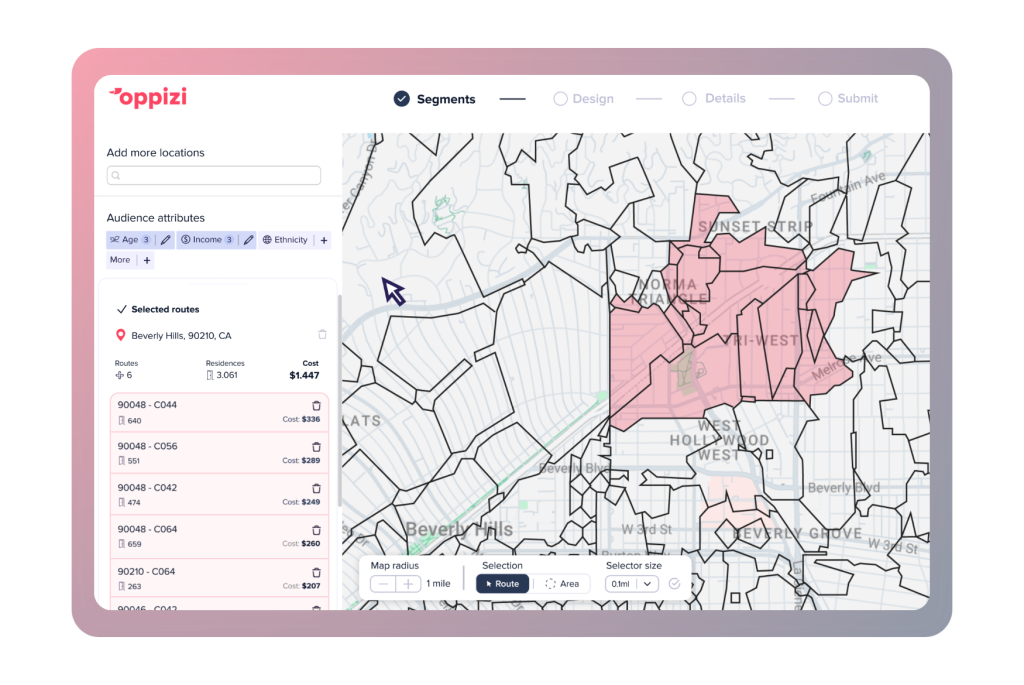
Let’s say you run a pizza shop. You might choose neighborhoods with lots of homes and families. A lawn care business might focus on suburban areas with larger yards. A real estate agent might look for places with new residents.
Choosing the right area is one of the most important steps, so take your time with the map.
Which businesses benefit most from EDDM?
If your business serves a local area, EDDM can be a great way to get the word out. It’s especially helpful for companies where most people nearby could use your product or service.
Businesses that often use EDDM include:
- Restaurants and cafes
- Real estate agents
- Local gyms
- Home services like cleaning or repairs
- Auto shops and car dealerships
- Dentists and health clinics
- Retail stores and boutiques
If local foot traffic matters to your business, EDDM is worth considering.
What can you send with EDDM?
EDDM mail needs to follow USPS size guidelines. These are known as “flats.” Your mailer has to fit within certain dimensions:
- Minimum: 6.125 x 11.5 inches or 10.5 x 6.25 inches
- Maximum: 12 x 15 inches
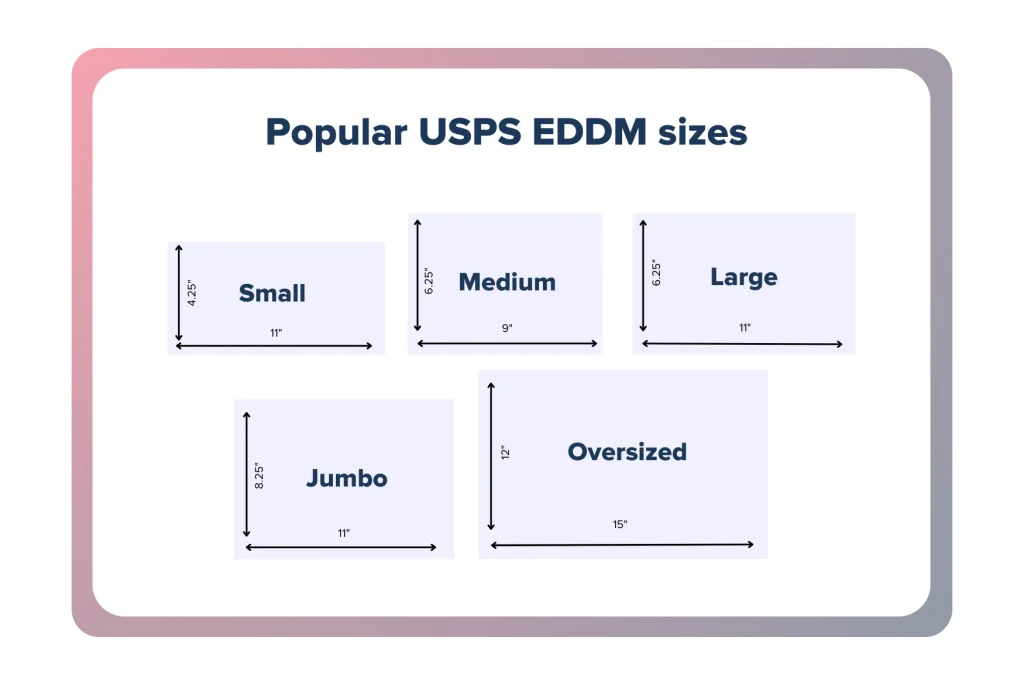
Some of the most common formats are:
- Postcards
- Flyers
- Folded mailers
- Brochures
According to the USPS, newsletters and postcards are the top choices for direct mail. About 66% of US marketers use them. Self-mailers come next at 56%. Catalogs are used by 48%, and 45% still send out packages.
Different industries use different styles. For example:
- Restaurants often send menus, coupons, or weekly specials
- Real estate agents send “just listed” or “just sold” cards
- Gyms might mail free passes or limited-time offers
- Contractors share project photos or service menus
Whatever you send, make sure it includes the required USPS markings. If you’re unsure, many EDDM providers offer templates you can use.
How does EDDM compare to digital marketing?
Most businesses use digital ads, social media, and email. These channels are fast and easy to track. But direct mail has one big advantage: people actually see it.
Most US marketers say direct mail drives website visits, with 77% reporting this. About 64% say it leads to purchases. Another 56% say it results in signups for programs, and 53% say it brings people into stores.
Emails often get ignored. Digital ads can be skipped or blocked. But a postcard in the mailbox is hard to miss. Here’s how EDDM stacks up:
- Visibility: Mail stands out. Ads get lost in the scroll.
- Lifespan: A postcard can sit on a counter for days. An email is gone in seconds.
- Cost: Digital ads need constant updates and bidding. EDDM has a flat rate.
- Targeting: Digital tools target by age, interests, or income. EDDM targets entire neighborhoods with no data costs.
Used together, EDDM and digital marketing can work well. A flyer can send people to your website, social pages, or a special offer through a QR code.
Why choose EDDM?
EDDM gives you a few clear advantages:
- You don’t need a mailing list
- It’s cost-effective compared to other types of mail
- Bigger mailers get more attention in the mailbox
- You can target by zip code, route, or neighborhood
- It’s great for reaching people who live or work nearby
You’re not fighting for attention in an email inbox or on a screen. Your flyer goes straight to real mailboxes, where people still notice and read.
Combining EDDM with digital marketing
EDDM is even more effective when you pair it with online tools. You can grab attention in the mailbox, then follow up digitally.
Here’s how to connect the two:
- Add a QR code that links to a landing page, coupon, or video
- Match your flyer design with your social media posts
- Use online ads in the same zip codes you’re mailing to
- Offer something in exchange for an email or sign-up, then follow up
This kind of mix helps people remember you and makes them more likely to take action.
Common questions about EDDM
What’s the difference between direct mail and EDDM?
With direct mail, you need a mailing list. You send pieces to specific names and addresses.
With EDDM, you don’t need a list. USPS delivers your flyer to every home or business along the routes you choose.
How does EDDM work with USPS?
You pick your delivery routes using the USPS EDDM tool. Then, you print your flyers, bundle them the right way, and drop them off at the post office. USPS delivers them to every address on the route.
What kind of mail qualifies for EDDM?
Your flyer has to meet USPS size rules. It needs to be between:
- Minimum: 6.125″ x 11.5″
- Maximum: 12″ x 15″
It must also include EDDM markings and be bundled as required. You need to send at least 200 pieces per day.
Is EDDM right for your business?
Ask yourself:
- Do you want to target people based on location?
- Is your offer relevant to most people in the area?
- Are you looking for a low-cost way to promote your business offline?
If you said yes to any of these, EDDM could be a good fit. EDDM.com was built to make this easy. We help you from start to finish—no experience needed.
How to get started
You don’t need to navigate the process alone. EDDM.com makes it easy to send Every Door Direct Mail from start to finish. Our platform helps you pinpoint the most relevant areas based on real data—so your message lands in the right mailboxes, not just any mailboxes.
You don’t have to worry about forms, bundling rules, or delivery timelines. We manage all of that behind the scenes. EDDM.com runs your campaign end-to-end. You get the reach of EDDM with none of the manual work—and full visibility into performance from day one.
Ready to launch? Let us take care of the heavy lifting so you can focus on results.